Who Builds for the Billion?
There are moments when knowledge does not arrive through books or structured lectures, but through the quiet authority of lived experience. I have increasingly come to believe that the most important knowledge comes from listening—listening to people as they recount what they have built, what they have struggled against, and what they have learned in the process. These narratives are never entirely free from bias; no human telling ever is. Yet, when spoken openly before an audience, they carry a certain irreducible truth. One cannot sustain a falsehood in full public view for long.
Perhaps that is why platforms like TED have become so relevant in our times. They are not merely stages for ideas; they are spaces where experience is distilled into insight. I have had the privilege of standing on such a stage myself—speaking on “Innovation is All about New Vision” in 2019 at MVR College of Engineering & Technology, Hyderabad, and later on “Connecting Human & Artificial Intelligence” in 2024 at the BITS Hyderabad Campus. Each time, I came away with the same realisation: innovation is not an abstract construct. It is deeply human, shaped as much by intent as by intellect.
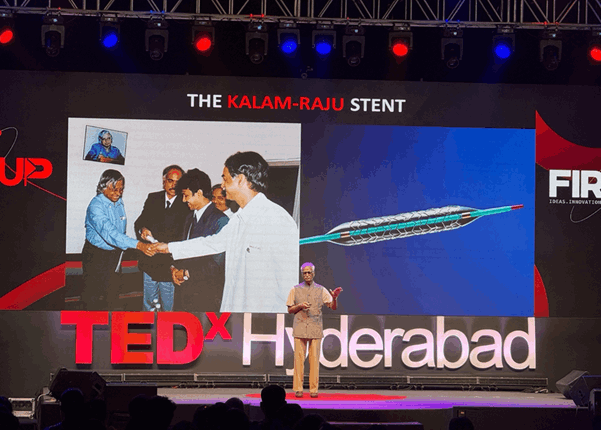
It was in this frame of mind that I attended a talk by Dr B. Soma Raju on innovation in medicine. What unfolded was not merely a recounting of achievements, but a journey into the very anatomy of innovation itself.
He spoke of a time in the mid-1990s when the idea of developing an indigenous coronary stent took root—not as a technological ambition, but as a response to an ethical discomfort. For a vast majority of patients, the choice was stark: health or affordability, survival or surrender.
The challenge was formidable. A coronary stent is not just a device; it is a silent companion to the human heart, required to endure its relentless rhythm in an environment saturated with oxygen, without corroding, without failing. It demands a material that is both resilient and biocompatible—a rare balance.
At that time, I found myself drawn into this effort, entrusted with developing the required steel, working alongside a metallurgical scientist and my seniors at DMRL—Dr. A. Venugopal Reddy and Dr. Koneru Bose. We navigated a path that was as much about science as it was about purpose. Innovation, I realised then, is rarely a straight line—it is a convergence of conviction, collaboration, and courage.
Three decades later, listening to Dr. B. Soma Raju narrate that journey with clarity and authenticity felt like revisiting an unfinished conversation with time. He spoke of the stent, of pioneering balloon valvuloplasty, of the courage to challenge the status quo, and of the subtle yet decisive role of political will. Beneath his words, one could sense the deeper currents of innovation—the interplay of dominant forces and quiet rebellions, the constant churning of the human mind striving to do better. The audience responded with a standing ovation. It was a moment of collective recognition.
And yet, as I stepped out of the hall, a question lingered. Not about the past, but about the present. What happens when innovation itself becomes captured?
Not captured in a dramatic sense, but gradually absorbed—by corporate priorities, by regulatory frameworks, by distribution systems, and ultimately by markets that determine what is worth building. When science aligns primarily with profitability, the question quietly shifts—from what is needed to what will sell. And then, inevitably, another question arises: Who builds for the needy billion?
There was a time when Dr A. P. J. Abdul Kalam articulated a vision that sought to bridge this gap—the idea of civilian spinoffs from defence technology. It was a powerful model: technologies developed in the pursuit of national strength could be redirected towards societal well-being. It was not merely a transfer of technology; it was a transfer of intent.
That bridge, today, seems washed off.
In its place stands a new ferry service—incubation centres, start-ups, venture capital, valuation cycles. It is energetic, ambitious, and in many ways necessary. But it is also shaped by a different logic. Innovation is nurtured—but within the boundaries of market viability.
Those who align with the “Big Machine” find their place within it. They are rewarded, absorbed, and elevated. Those who do not frequently find themselves on the margins. This is not a failure of individuals; it is a structural imbalance.
For a country like India, this imbalance is not merely an economic concern. It is a moral one.
A billion people cannot be served by an innovation designed only for those who can pay. Nor can we afford to romanticise a past that cannot be recreated. The real question is not whether we choose between enterprise and public good—but whether we can integrate the two.
Perhaps the answer lies not in building more institutions, but in nurturing a different kind of mindset—one that sees innovation as both a scientific pursuit and a social responsibility.
We need pathways where public-funded research aligns itself with essential healthcare needs, where affordability is not an afterthought but a design principle. A low-cost device that reaches millions carries a significance that no valuation can fully capture.
We must also recognise that innovation does not end with invention. It must travel—through manufacturing, through distribution, through systems that ensure it reaches those who need it most. Affordability is not an accident; it is engineered.
As we step further into an era shaped by artificial intelligence, another dimension emerges. Technology now has the capacity to learn not just from structured data, but from human experience itself. Every lived experience is no longer just a memory—it is a potential data point in the making of future solutions.
But for that to happen, we must first listen.
Listen not selectively, but inclusively. Listen not only to success, but to struggle. For in those voices lies a different kind of insight—one that cannot be engineered, only understood.
As I reflect on that evening, I am left with a simple, persistent thought:
Innovation is not merely about changing the status quo. It is about choosing whose status quo we seek to change.
And in that choice lies the defining question of our times:
Who builds for the needy billion?
In that answer lives the spirit of Dr. A. P. J. Abdul Kalam, who saw beyond laboratories and launch pads into the lives of ordinary people. In that answer resonates the work of Dr. B. Soma Raju, who chose not the convenience of import, but the courage of creation.
And in that answer rests a quiet blessing—for the countless innovators who continue nevertheless.
Who persist without certainty. Who build without applause. Who fail and rise again—not for valuation, but for value.
May their tribe grow. For it is they, in the end, who will build for the billion.
-Arun Tiwari
